
Restore Healthy Movement: The Biomechanics of Back Pain

Back pain isn’t always caused by a dramatic injury. In many cases, it develops gradually from the way we sit, lift, and move through daily life. Modern habits place unusual stress on the spine, and over time these stresses change how joints, muscles, and discs function. The result is a cycle of stiffness, tension, and discomfort that often keeps returning until the underlying biomechanics are corrected. Research consistently shows that daily mechanical stress is one of the strongest predictors of episodic or chronic low back pain (Steele et al., 2013).
A growing body of evidence shows that chiropractic care plays an important role in both treating back pain and maintaining long-term spinal health. By restoring joint movement, improving neuromuscular control, and reducing muscle tension, chiropractic treatment helps people recover while reducing future flare-ups. Clinical guidelines—including those from the American College of Physicians—recommend spinal manipulation as a first-line therapy for acute, subacute, and chronic low back pain (American College of Physicians, 2017).
This guide explains how everyday movement patterns contribute to back pain and how evidence-based chiropractic care supports both recovery and long-term spinal health.
How Sitting, Lifting, and Daily Habits Affect Spinal Health
Prolonged sitting is one of the most common contributors to low back pain. Research shows that sitting increases pressure on lumbar discs, reduces lumbar lordosis, and decreases joint lubrication, which increases stiffness over time (Cramer & Darby, 2014). When joints do not move frequently, they receive less synovial fluid and fewer nutrients, which can contribute to discomfort and restricted mobility.
Movement variability—the body’s natural need to change positions frequently—is another important concept. Holding any posture for too long, even a “perfect” one, causes muscular fatigue and joint irritation (Hägg, 1991). Over time, this can weaken stabilizing muscles and disrupt normal biomechanics.
Lifting-related injuries often occur due to faulty mechanics. Twisting while lifting, rounding the spine, using the low back instead of the hips, or carrying loads far from the body all increase spinal stress (Roffey et al., 2010). Even when no immediate injury occurs, repetitive stress gradually irritates joints and soft tissues, eventually triggering sudden pain or muscle spasms.
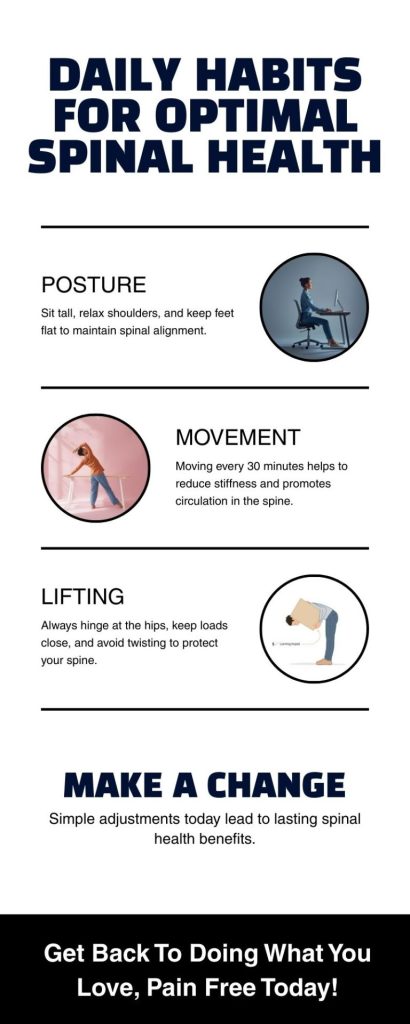
Download a copy of this infographic.
How Poor Spinal Health Creates Muscle Pain and Joint Dysfunction
Back pain often originates from joint restriction rather than a muscle injury. When a spinal joint stops moving properly, surrounding muscles reflexively tighten in a protective response known as muscle guarding (Liebenson, 2007). While this tightening is meant to stabilize the area, it often becomes a source of pain itself.
Disc health is also affected by daily habits. Discs rely on movement to circulate nutrients and maintain hydration. Reduced movement or prolonged loading—like sitting for hours—limits this process and contributes to stiffness and irritation (Cramer & Darby, 2014).
The spine also plays a major role in proprioception, the body’s sense of position and movement. When a joint becomes restricted, the sensory input from that area becomes less accurate, altering muscle activation patterns and stability (Hallgren et al., 2014). This creates a cycle of poor control, reduced mobility, and further compensation, especially during bending, lifting, or twisting.
How Chiropractic Care Helps Treat Back Pain
Chiropractic care is supported by a strong base of evidence for mechanical back pain. Spinal manipulation improves segmental mobility, reduces pain, and supports functional recovery (Rubinstein et al., 2011). Clinical guidelines recommend chiropractic adjustments as an effective nonpharmacological treatment for low back pain across several stages, from acute to chronic (American College of Physicians, 2017; Wong et al., 2017).
Adjustments help restore normal movement to restricted joints. Research shows that spinal manipulation reduces muscle tension, improves proprioception, and normalizes muscle activation patterns (Bialosky et al., 2009; Gevers-Montoro et al., 2021). When a restricted joint begins moving properly again, surrounding muscles often relax, reducing pain and improving range of motion.
Soft-tissue therapy frequently enhances these benefits. Myofascial release, stretching, and trigger-point techniques reduce chronic muscular tension and improve flexibility. Evidence shows that addressing both joint restriction and soft-tissue dysfunction leads to better outcomes than treating either alone (Cagnie et al., 2013).
Chiropractors also assist with acute injuries such as sudden lifting strains. Evidence supports remaining active rather than resting excessively, and chiropractic care helps patients move safely while identifying aggravating patterns (Hancock et al., 2011). Chiropractors also teach proper biomechanics, helping prevent re-injury.
A major benefit of chiropractic care is the correction of dysfunctional movement patterns. Chiropractors evaluate posture, gait, lifting mechanics, and functional movements, providing personalized strategies that reduce mechanical stress and enhance spinal efficiency (Liebenson, 2007).

Download a copy of this infographic.
Why Chiropractic Maintenance Care Supports Long-Term Spinal Health
Chiropractic care is valuable not only for treating pain but also for maintaining spinal health. Maintenance care involves periodic visits aimed at preventing recurrent episodes. Studies indicate that patients who receive maintenance care experience fewer future episodes of back pain than those who seek care only when symptoms reappear (Morenus, 2019).
Maintenance care helps keep spinal joints mobile, supporting disc hydration and reducing the likelihood of restrictions turning into painful episodes. This proactive approach is especially beneficial for people with sedentary jobs, athletes, individuals with repetitive physical work, and those with a history of back pain.
Key benefits of maintenance care include:
* Sustaining healthy joint motion
* Reducing muscle tension before it leads to pain
* Supporting more balanced posture
* Improving how the nervous system controls movement
* Preventing re-injury during daily tasks or workouts
By keeping the spine moving well, maintenance care supports long-term comfort and resilience.
Home and Workplace Strategies to Reduce Daily Spinal Stress
Daily habits contribute greatly to spinal health. Even small adjustments can significantly reduce mechanical stress.
Regular movement is one of the most effective strategies. Standing or stretching every 30 minutes reduces disc pressure and increases joint lubrication (Cramer & Darby, 2014). Movement “snacks”—brief, frequent motions—help prevent stiffness.
Ergonomic improvements also make a measurable difference, including:
* Supporting the lumbar spine to maintain natural curvature
* Positioning screens at eye level
* Keeping hips and knees at roughly 90 degrees
* Ensuring feet are flat on the floor
* Alternating between sitting and standing
Proper lifting mechanics protect the lower back as well. Using a hip hinge, keeping loads close, avoiding rotation, and activating the core and legs all reduce mechanical stress (Liebenson, 2007).
Strengthening stabilizing muscles—especially the deep core and glutes—improves spinal control. Studies show that the multifidus muscle often shuts down after back pain and must be specifically retrained to restore lumbar stability (Hides et al., 1996).
When to See a Chiropractor
Persistent stiffness, recurring pain, or discomfort related to sitting, lifting, or bending are strong signals to seek chiropractic care.
Other reasons to visit include:
* Muscle tightness that repeatedly returns
* Pain radiating into the hips or legs
* Reduced mobility impacting daily life
* Recurrent episodes of back pain
* Desire for a proactive spinal wellness plan
Chiropractors also identify red flags that require medical evaluation, ensuring safe, appropriate care.
Your Spine Is Built to Move — Keep It Healthy
Back pain caused by daily habits is incredibly common, but it doesn’t have to become a long-term problem. Understanding how sitting, lifting, and repetitive stress affect your spine empowers you to make better choices throughout your day. Chiropractic care supports this by restoring joint motion, reducing pain, improving movement, and helping prevent future episodes.
With both treatment for acute issues and maintenance care for long-term spinal health, chiropractic care helps patients stay active, mobile, and pain-free.
References
American College of Physicians. (2017). Noninvasive treatments for acute, subacute, and chronic low back pain: A clinical practice guideline. Annals of Internal Medicine, 166(7), 514–530. . https://doi.org/10.7326/M16-2367
Bialosky, J. E., Bishop, M. D., & George, S. Z. (2009). Spinal manipulative therapy for low back pain: A physiological perspective. Journal of Orthopaedic & Sports Physical Therapy, 39(9), 527–540. https://pubmed.ncbi.nlm.nih.gov/19797305/
Cagnie, B., Dewitte, V., Barbe, T., Timmermans, F., Delrue, N., & Meeus, M. (2013). Physiologic effects of dry needling. Current Pain and Headache Reports, 17(8), 348. https://pubmed.ncbi.nlm.nih.gov/23801002/
Cramer, G. D., & Darby, S. (2014). Basic and clinical anatomy of the spine, spinal cord, and ANS (3rd ed.). Elsevier. https://www.ncbi.nlm.nih.gov/nlmcatalog/101595897
Ferreira, M. L., Ferreira, P. H., Maher, C. G., Herbert, R. D., Refshauge, K., & Latimer, J. (2002). Effect of spinal manipulative therapy on spinal stiffness in chronic low back pain patients. Manual Therapy, 7(4), 193–199. https://doi.org/10.1054/math.2002.0484
Gevers-Montoro, C., Provencher, B., & Piché, M. (2021). Spinal manipulative therapy alters muscle tone and neural excitability in people with chronic low back pain. Journal of Electromyography and Kinesiology, 58, 102566. https://doi.org/10.1016/j.jelekin.2021.102566
Hägg, G. M. (1991). Static work loads and occupational myalgia—a new explanation model. European Journal of Applied Physiology, 64(6), 579–584. https://doi.org/10.1007/BF00625070
Hallgren, R. C., Cantu, J. A., Parker, J., & Nelson, R. (2014). Sensorimotor function in low back pain: A review. Pain Physician, 17(1), 109–128. https://pmc.ncbi.nlm.nih.gov/articles/PMC9390858/
Hancock, M. J., Maher, C. G., Laslett, M., Hay, E., & Koes, B. (2011). What happened to the “bio” in the bio-psycho-social model of low back pain? European Spine Journal, 20(12), 2105–2110. https://pubmed.ncbi.nlm.nih.gov/21706216/
Hides, J. A., Richardson, C. A., & Jull, G. A. (1996). Multifidus muscle recovery is not automatic after resolution of acute low back pain. Spine, 21(23), 2763–2769. https://doi.org/10.1097/00007632-199612010-00011
Liebenson, C. (2007). Rehabilitation of the spine: A practitioner’s manual (2nd ed.). Lippincott Williams & Wilkins. https://pmc.ncbi.nlm.nih.gov/articles/PMC1924653
Morenus, H. (2019). Evidence-based approach to chiropractic maintenance care. Journal of Chiropractic Medicine, 18(2), 98–105. https://doi.org/10.1016/j.jcm.2019.01.003
Roffey, D. M., Wai, E. K., Bishop, P., Kwon, B. K., & Dagenais, S. (2010). Causal assessment of occupational lifting and low back pain: Systematic review. Spine Journal, 10(6), 554–566. https://doi.org/10.1016/j.spinee.2010.03.033
Rubinstein, S. M., Terwee, C. B., Assendelft, W. J. J., de Boer, M. R., & van Tulder, M. W. (2011). Spinal manipulative therapy for acute low-back pain. Cochrane Database of Systematic Reviews, (2), CD008880. https://doi.org/10.1002/14651858.CD008880.pub2
Steele, J., Bruce-Low, S., & Smith, D. (2013). A review of the incidence and risk factors for back pain. Journal of Exercise Rehabilitation, 9(5), 436–445. https://pubmed.ncbi.nlm.nih.gov/24462537/
Wong, J. J., Côté, P., Sutton, D. A. M., et al. (2017). Clinical practice guidelines for the management of low back pain. Journal of Manipulative and Physiological Therapeutics, 40(3), 173–192. https://doi.org/10.1016/j.jmpt.2017.02.002