
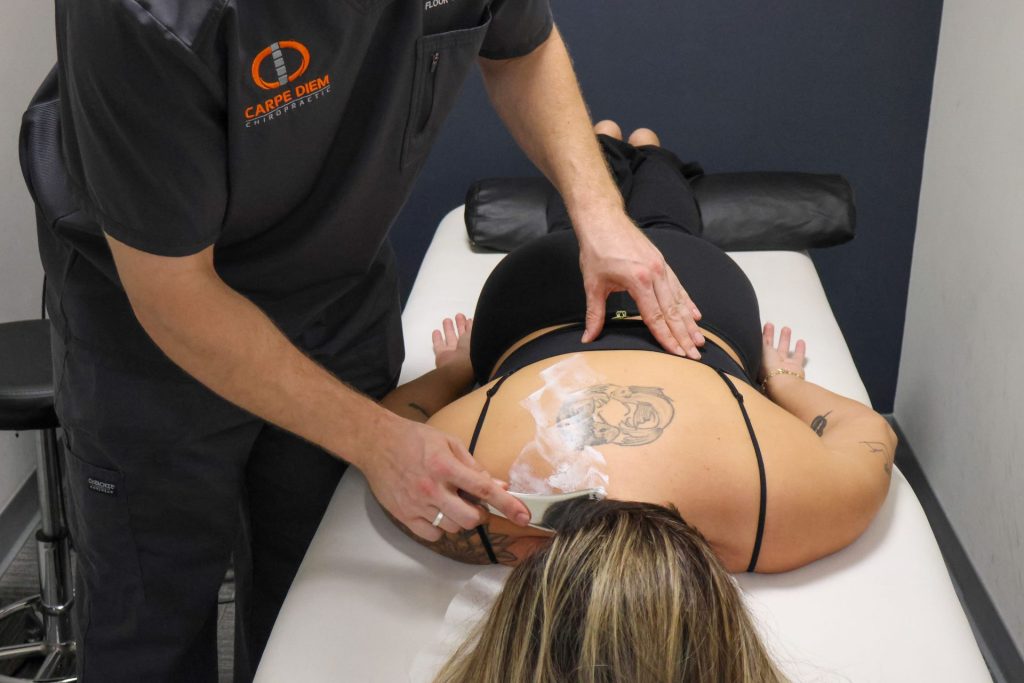
A healthy spine is more than anatomy—it’s your foundation for strength, movement, and a life lived without limits. When your spine functions well, your entire body performs better. You move with confidence. You lift with power. You wake up without stiffness holding you back. But when mobility decreases, alignment falters, or the body loses muscular support, the entire system feels the strain—impacting how you work, train, sleep, and live.
At Carpe Diem Chiropractic, we focus on restoring the spine as the powerful, dynamic structure it was designed to be. Through evidence-based care, targeted strengthening, and movement-focused rehabilitation, we help you rebuild stability, improve mobility, reduce pain, and reclaim control of your health. Our goal is not just relief—it’s transformation.
What a Healthy Spine Really Looks Like
A healthy spine maintains its three natural curves—cervical, thoracic, and lumbar—each designed to absorb impact and distribute load evenly. When these curves are balanced, joints glide smoothly, discs remain hydrated, and muscles provide the stability needed for everyday life.
Each spinal segment protects nerve pathways essential for movement, strength, coordination, and organ function. Good alignment helps these nerves transmit signals efficiently, supporting your entire body.
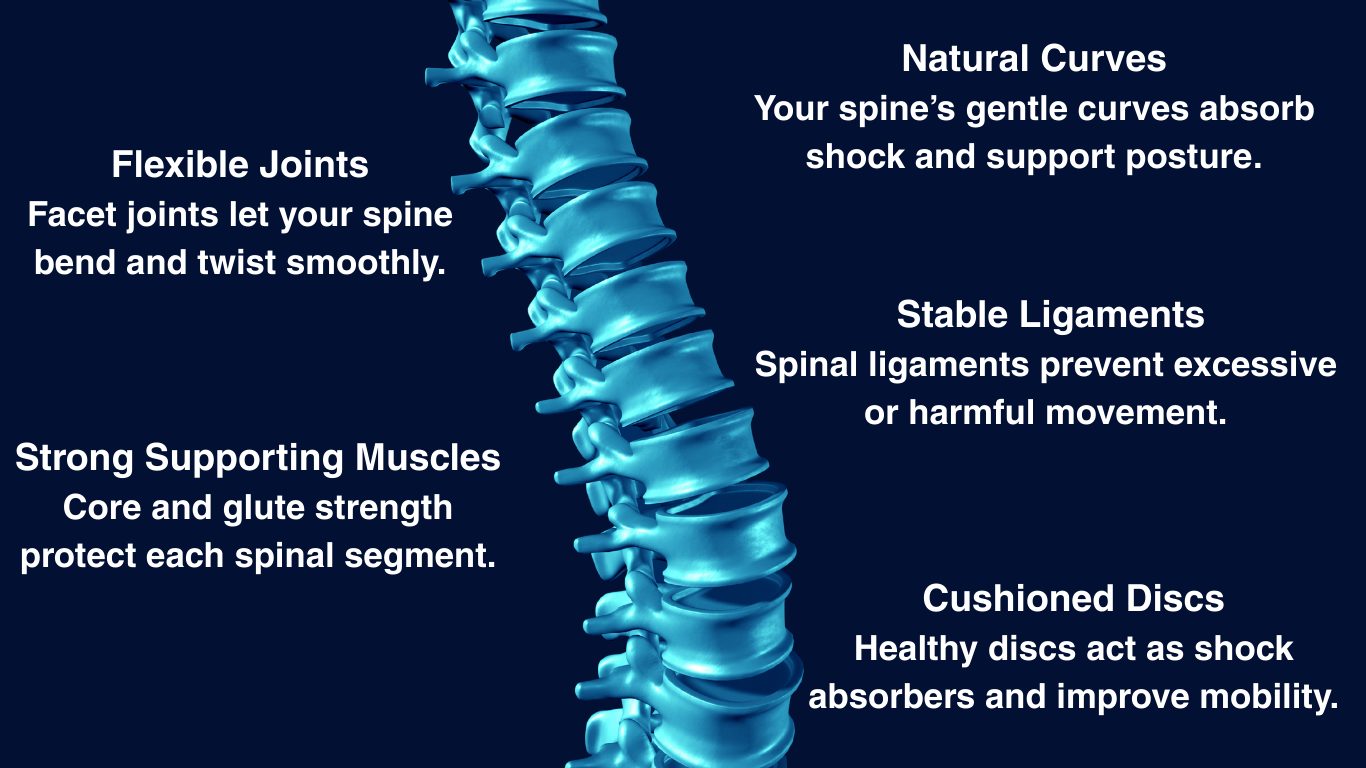
A well-functioning spine also relies on strong muscles. Deep stabilizers like the multifidus and transverse abdominis keep each vertebra steady, while the glutes and core reduce strain and prevent overload.
Why Maintaining Spinal Health Matters
When your spine moves well, your whole body performs better. Good spinal mechanics improve posture, reduce tension, enhance balance, and make daily activities easier. Long-term spinal health also reduces the recurrence of low back and neck pain—two of the most common conditions affecting adults worldwide.
Healthy spine function supports everything you do: sitting, lifting, walking, exercising, and sleeping. Research also links good spinal mobility to improved mood, better sleep, and higher energy levels. Caring for your spine is caring for your overall quality of life.
How Modern Stressors Disrupt Spinal Health
Today’s high-stress, low-movement lifestyle creates conditions that challenge spinal health.
- Prolonged sitting increases lumbar disc pressure by ~40%
Read the Case Study: https://pubmed.ncbi.nlm.nih.gov/11707767/ - Forward head posture adds 10–30 lbs of effective load per inch
Read the Case Study: https://pmc.ncbi.nlm.nih.gov/articles/PMC8915312/ - Sedentary habits weaken stabilizing muscles like the multifidus and glutes.
Read the Case Study: https://pmc.ncbi.nlm.nih.gov/articles/PMC4713798/
These patterns contribute to stiffness, poor movement, fatigue, and chronic pain. Without intervention, small issues become long-term limitations.
The Spine is a Dynamic System
The spine is not a rigid column—it is a dynamic system where joints, discs, muscles, ligaments, and nerves work together to support movement and absorb load. When one part loses mobility or control, the rest of the system compensates, often resulting in pain.
This interconnected system is why chiropractors assess the entire spine, not just the painful area.

How Carpe Diem Rebuilds Strength and Supports Lifelong Spinal Health
Our board certified chiropractors deliver evidence-informed, movement-focused approach to restore mobility, rebuild foundational strength, and teach patients how to protect and enhance their spinal health for the long term.
Restoring Motion and Reducing Pain
Healthy movement begins with joints that function the way they’re meant to.
Using gentle, precise spinal manipulation and mobilization, we restore normal motion in restricted segments—reducing irritation, easing muscle tension, and improving how the entire spine moves. These hands-on techniques are recommended by the American College of Physicians as first-line care for low back pain, supported by extensive clinical research. ACP Guidelines: When the spine moves better, you move better. And when mobility returns, strength and stability follow naturally.
Strengthening The Spine From The Inside Out
Stabilizing muscles must be retrained after injury or inactivity. Research shows the multifidus and transverse abdominis respond best to motor-control training and progressive loading. Read A Case Study
Strength Without Proper Movement Is Incomplete
We teach patients how to move properly, and with power—whether they’re lifting, bending, reaching, carrying, or returning to sport. By improving mechanics, we reduce unnecessary strain, protect vulnerable areas, and help the entire body move the way it was designed to.
Better movement patterns create better outcomes. Patients feel stronger, more confident, and more capable in their daily lives.
Why Movement Is Medicine
Spinal problems rarely appear overnight—they develop slowly, shaped by inactivity, stress, and years of moving in ways the body isn’t designed for. The good news: movement is one of the most powerful tools for reversing this pattern. When you move well and move often, you restore mobility, strengthen support systems, and give your spine exactly what it needs to stay healthy for the long term.
Reactivating Deep Stabilizers
True spinal strength starts with the muscles closest to the spine.
Deep stabilizers like the multifidus and transverse abdominis provide segmental control—keeping each vertebra supported, aligned, and protected. After injury, stress, or prolonged inactivity, these muscles often shut down or become delayed in activation. They don’t regain strength automatically—they must be retrained deliberately and progressively.
Rebuilding these stabilizers is essential for improving posture, reducing pain, and preventing future injuries.
Strength Training Protects the Spine
A strong spine is a resilient spine.
Research shows that resistance training improves disc hydration, bone density, muscular endurance, and load tolerance—all critical for long-term spinal health and chronic pain prevention. Even basic movements like hinging, squatting, walking, planking, or lifting contribute to a stronger, more adaptable spine. Read A Case Study here.
Strength training doesn’t just build muscle; it builds confidence, durability, and the capacity to handle life’s physical demands.
Movement Reduces Pain Sensitivity
When you move, you heal. Regular movement helps calm an overactive nervous system, increase circulation, reduce inflammation, and improve how the brain and body process pain. For many patients, this is the key to breaking the cycle of chronic discomfort.
Movement restores control.
Movement restores confidence.
Movement restores you.
What the Research Says About Chiropractic Care
Modern chiropractic care is grounded in clinical research and supported by decades of evidence demonstrating improvements in pain, mobility, function, and long-term spinal resilience. When combined with exercise, education, and strength-based rehabilitation, outcomes are even stronger. Here’s what high-quality research shows:
Low Back Pain
Spinal manipulation is one of the most effective non-invasive treatments for both acute and chronic low back pain. A major systematic review published in JAMA found that manipulation provided meaningful pain reduction and functional improvement compared to standard medical care. This is why multiple guidelines—including the American College of Physicians—recommend chiropractic manipulation as a first-line treatment for low back pain.
Neck Pain
For neck pain, research is even more clear: the combination of manual therapy + targeted exercise produces the best outcomes. According to a Cochrane Review, cervical manipulation and mobilization paired with strengthening improves:
- Neck pain intensity
- Range of motion
- Neuromuscular control
- Functional performance
This combined, multimodal model is central to evidence-based chiropractic care.
Headaches
Many headaches originate from dysfunction in the upper neck—and chiropractic care directly addresses these contributing factors. A recent systematic review shows that spinal manipulation and manual therapy significantly reduce:
- Frequency of cervicogenic headaches
- Intensity of tension-type headaches
- Disability associated with recurrent headache episodes
Patients often report not just fewer headaches, but better overall neck mobility and reduced stress on the upper spine.
The Long-Term Benefits of Chiropractic Care
Chiropractic care is more than symptom relief—it builds a stronger, more adaptable spine. With consistent, evidence-informed treatment, patients experience:
- Improved mobility and flexibility
- Reduced pain and inflammation
- Stronger stabilizing muscles
- Better posture and spinal alignment
- Enhanced balance and coordination
- Fewer flare-ups or recurring episodes
- Higher energy and better daily performance
- Greater physical confidence and resilience
Chiropractic care helps you not just feel better—it helps you move, live, and perform better.
Seize the Day. Strengthen Your Spine.
Your spine is built for strength, motion, and adaptability. It’s meant to support your life—not limit it. With consistent, evidence-based care from Carpe Diem Chiropractic, you can rebuild your foundation, restore your mobility, and create a healthier, more resilient spine that carries you forward. Seize The Day. Not Your Back.
References
American College of Physicians. (2017). Noninvasive treatments for acute, subacute, and chronic low back pain: A clinical practice guideline from the American College of Physicians. Annals of Internal Medicine, 166(7), 514–530. https://doi.org/10.7326/M16-2367
Bialosky, J. E., Beneciuk, J. M., & Bishop, M. D. (2018). Effectiveness and mechanisms of spinal manipulative therapy for chronic musculoskeletal pain: A systematic review. Pain Physician, 21(3), E277–E288.
Gross, A., Langevin, P., Burnie, S. J., et al. (2015). Manipulation and mobilization for neck pain contrasted against inactive controls or another active treatment. Cochrane Database of Systematic Reviews, 2015(9). https://doi.org/10.1002/14651858.CD004249.pub4
Nachemson, A. (1981). Disc pressure studies. Spine, 6(1), 93–97.
Paige, N. M., Miake-Lye, I. M., Booth, M. S., et al. (2017). Association of spinal manipulative therapy with clinical benefit and harm for acute low back pain: Systematic review and meta-analysis. JAMA, 317(14), 1451–1460. https://doi.org/10.1001/jama.2017.3086
Panjabi, M. M. (2003). Clinical spinal instability and low back pain. Journal of Electromyography and Kinesiology, 13(4), 371–379. https://doi.org/10.1016/S1050-6411(03)00044-0
Sterling, M., Elliott, J., Cabot, P. J., et al. (2011). Whiplash-associated disorders: Clinical implications of current neurophysiological findings. Clinical Journal of Pain, 27(3), 168–175. https://doi.org/10.1097/AJP.0b013e3181fdbf0f
Van Tulder, M., Furlan, A., Gagnier, J., et al. (2020). Complementary and alternative therapies for low back pain. Spine, 45(17), 1235–1245.
World Health Organization. (2023). WHO guidelines for the management of low back pain. World Health Organization. https://www.who.int/publications/i/item/9789240075671
Yamazaki, J., Oka, H., & Nikaido, T. (2019). Biomechanical impact of forward head posture. Journal of Physical Therapy Science, 31(1), 65–68. https://doi.org/10.1589/jpts.31.65
Zoidis, J. D., & Falla, D. (2015). Deep cervical flexor training reduces neck pain: A randomized controlled trial. Manual Therapy, 20(3), 492–499. https://doi.org/10.1016/j.math.2015.01.004

